Individual Transition (Police, Military, Fire, Paramedic)
Dr Kate Martin's research:

The individual experience in the police, military or emergency services environment is unique to that type of employment.
Individuals enter service as new recruits and are subjected to intensive and often unique training in an academy style environment. Outside of these organisations, civilians latch on to terms like ‘bootcamp’ to reflect intense experiences that are matched to the strength, resilience, and determination that we know to be associated with the services.
The individual experience within the organisations is intense. They are devolved of their previous identity as a civilian, put through the intense training regime, and ejected into the workspace as a new form of person. They are placed in a team, operationalised through uniforms and equipment, and then placed in a role that they will fulfill in one form or another until they separate from service.
This is systematic for the organisation. It is a process of employment that is usual for any workplace except for the level and intensity of the onboarding to the job.
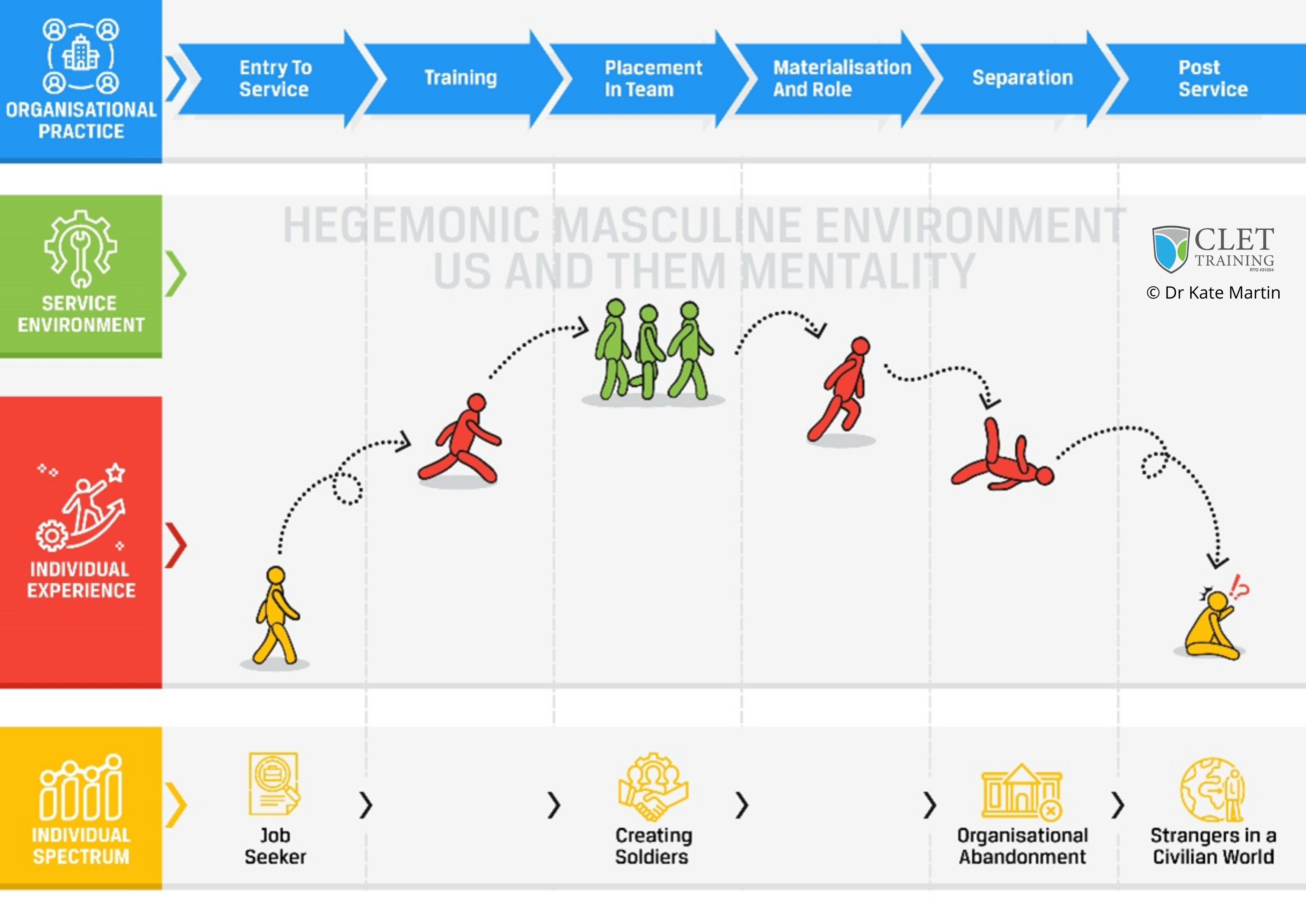
At some point in their lives, the individual will exit the organisation. Whether this is through end of service at retirement, through voluntary resignation, through forced resignation, through medical separation, or any other imagined means; the separation will occur.
At this time in the individual's lives, they will face considerable challenges in returning to their previously held identities as civilians. By the term civilians, we mean non-service personnel.
Separation for the individuals means they have been ejected from their role in the organisation, ejected from their team, ejected from an environment that they felt they belonged, and left to fend for themselves.
You may ask, isn’t that normal for any job? Yes, it is. Employees enter an organisation, they stay their term, they leave, and they find other employment.
Yet for members of the service organisation, their immersion into the organisation culture, practices, processes, and identity is so complete that they struggle to find their way outside of service.
The individuals feel abandoned by the organisation, they are perplexed as to why they feel the way they do, and they struggle to move forward post-service.
This may present in the smallest of ways or be completely overwhelming and debilitating.
But it does present!
Posted by CLET on 06/11/2021